
The hope for a permanent resolution to the Iranian conflict diminished during the third quarter and oil prices rebounded to the $90-$95/bbl level by quarter end. Sustained higher energy prices have put the Fed in a tightening mode to help cool things down. Rising interest rates have led to a divergence in equity markets and a return to the AI stocks generating most of the positive attribution. AI continues to contribute to U.S. growth with GDP coming in higher than most forecasters expected at the beginning of the year.
The broadening of the market we saw in the first half of the year began to diminish in the 3rd quarter. The S&P 500 ended the quarter up 2.3% and returned 12.7% since the beginning of the year. Small-cap stocks and the S&P 500 equal weight index, which had outperformed in the first half, both finished the quarter down. Energy stocks benefited from ongoing high oil prices and Technology stocks benefited from strong capex into the AI buildout. Interest- sensitive stocks such as Utilities, Real Estate, and Industrials all had a tough quarter.
The third quarter was the worst quarter for bonds since 2022 as the yield on the 10-year rose above 5% for the first time in nearly 20 years. The Fed moved towards a tightening bias and corporate debt issuance picked up dramatically. Municipal bonds were hit the hardest, losing nearly 6% for the quarter.
Interest Rates
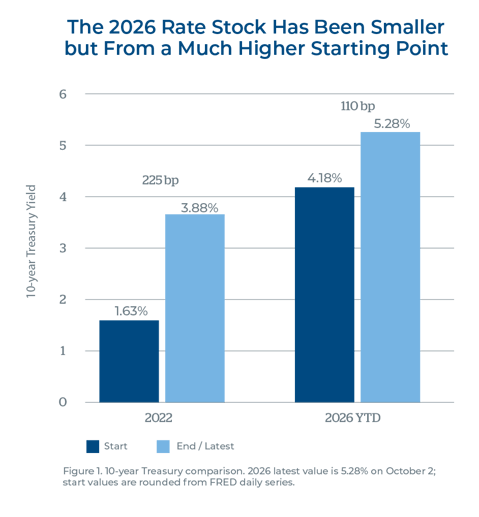
The yield on the 10-year U.S. Treasury increased by 110 bps since the beginning of the year to the highest level in nearly 24 years. Rates have moved higher due to higher inflation expectations as well as increased government spending. The shock from the increase is much smaller than the 2022 increase. The AI buildout is not currently as sensitive to rates.
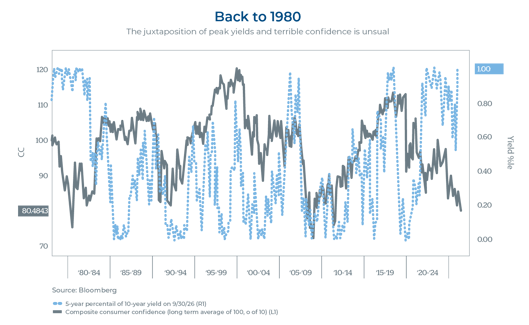
Typically, higher rates coincide with a fast-growing economy and high consumer confidence.Consumer confidence is at historically low levels, mostly due to inflation expectations.
Growth
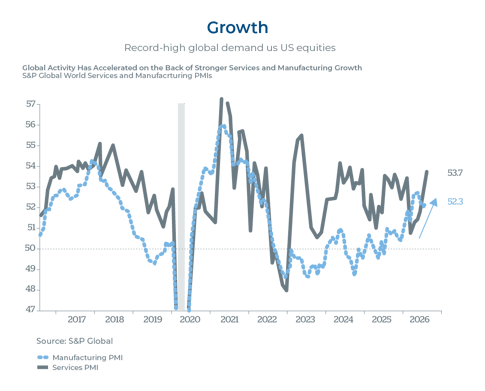
Global economic activity continues to move higher, driven mostly by the AI buildout. The manufacturing of chips and the buildout of data centers are important contributors to growth.
While positive, the reliance on the AI buildout could cause economic vulnerability with a slowdown. The expansion of semiconductor production and China’s ramp-up in production could cause a glut in the near future.
Consumer
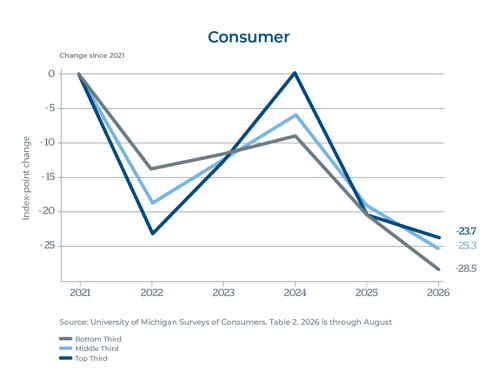
Consumer confidence across household wealth levels has fallen quickly since 2024.Tariffs and the Iran conflict have been major contributors to higher inflation. Higher inflation, especially higher gas prices, leads to lower confidence. While we continue to see a K-shaped economy, even wealthier households are becoming less confident.
Consumer
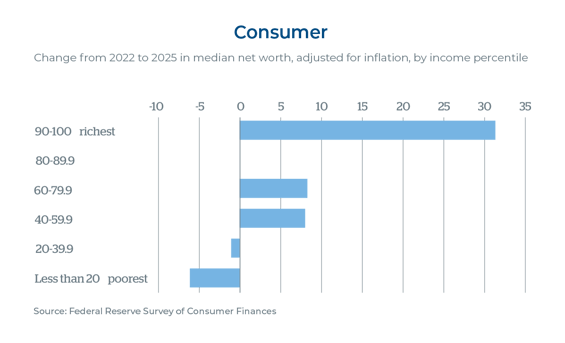
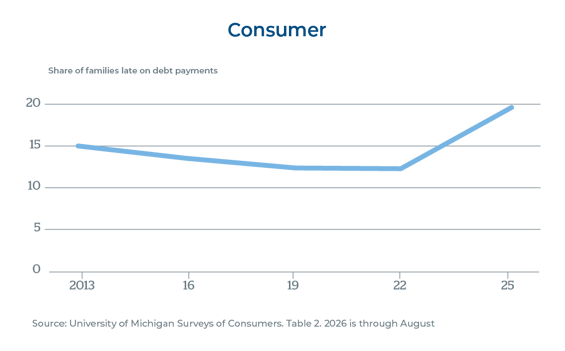
The K-shaped economy really shows up in the change in inflation-adjusted net worth by household since 2022. The wealthiest have seen their net worth increase on average by over 30%, while the poorest have seen a decline of over 5%. While overall household wealth is higher, we have seen an increase in households that are late on debt payments. The economy is heavily driven by the stock market.
Fixed Income
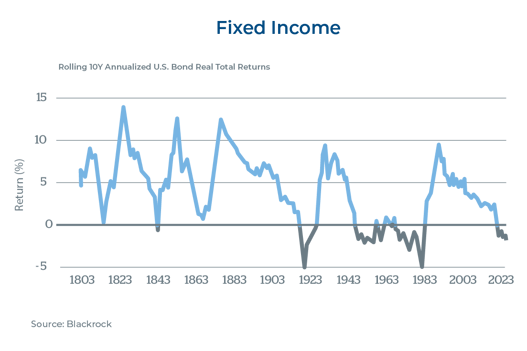
It has been extremely rare for real bond returns to be negative over a 10-year time horizon, but we are currently in one of those periods. This primarily driven by the fact that the 10-year U.S. Treasury yield was under 2% in 2016 and below 1% in 2020. Going forward, we would expect positive returns unless we experience an environment similar to post World War II.
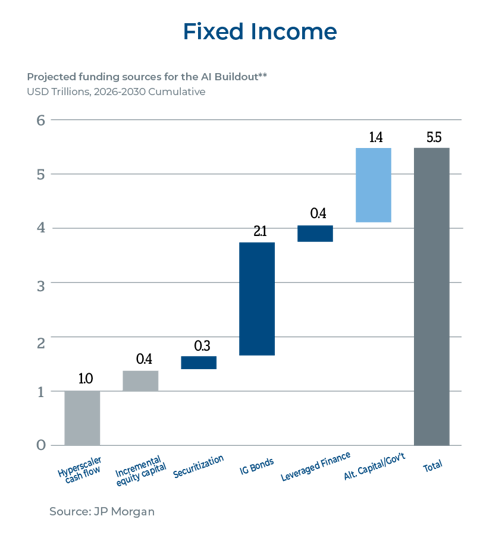
Government debt has been expanding for some time, and now we are likely to see corporate debt issuance expand with the AI buildout. Expectations are that $2.1tn of corporate bonds will be issued over the next five years to help fund the buildout. This will put more pressure on rates.
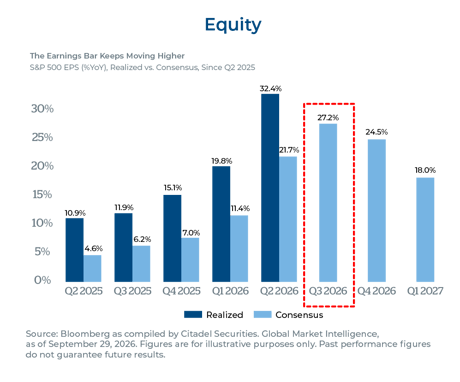
EquityS&P 500 earnings continue to beat estimates, allowing for markets to continue to go higher without P/E multiples expanding. Nearly 60% of the earnings growth and nearly two-thirds of return is coming from less than 50 stocks. Earnings estimates have moved higher, so year-over-year earnings per share will need to deliver to maintain valuations. |
|
|
|
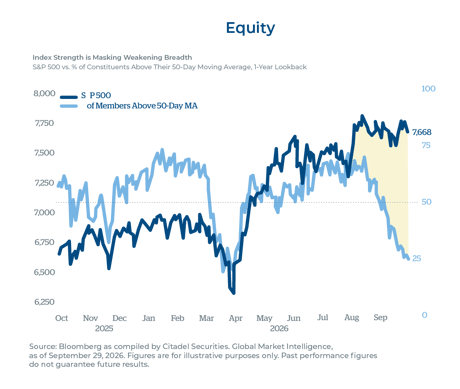
While the S&P 500 continues to reach new highs, it is driven by a concentrated number of stocks. Typically, when we see a low number of stocks below their 50-day moving average, the market is moving lower. Ultimately, for the rally to be sustainable we need to see a broadening out of stocks trading above the 50-day moving average. The users of AI(financials, health care,etc.) have earnings estimates in the low single digits.
|
|
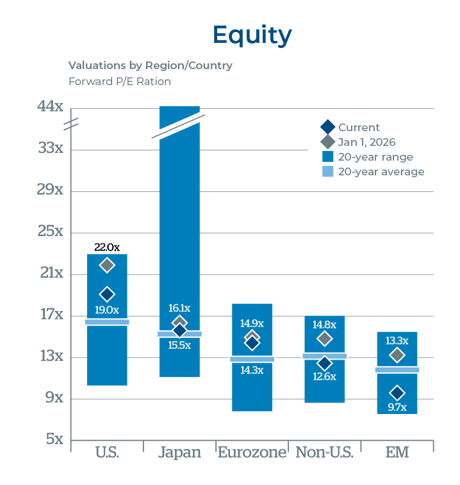
While P/E ratios have come down, the U.S. still trades at a premium to the 20-year average. Non-U.S. stocks and especially emerging markets trade at a discount. Within EM, we are careful to avoid some of the overlap in the AI buildout by having some active exposure. |
|
2026 Fourth Quarter Outlook
The U.S. economy continues to grow faster than projected at the beginning of the year, as the consumer has remained resilient and the AI buildout continues to pick up pace. We expect the third quarter to be the strongest in terms of GDP growth, with some deceleration in the fourth quarter. Expectations are for U.S. GDP growth to finish the year in the 2.5% range. While the Fed continues to move rates higher, corporate earnings also continue to come in higher than expectations.
Major U.S. stock indices continue to hit record highs as strong corporate earnings have allowed P/E ratios to come down from elevated levels. The conversation has moved from a valuation bubble to an earnings bubble. Valuations are supported by earnings, but are earnings sustainable and able to justify price levels moving forward? While the S&P 500 has hit new record highs, the vast majority of stocks are trading well below their all-time highs as the returns have mostly been generated by fewer than 10% of the companies in the index. We expect to see some rotation into other names that will benefit from the use of AI relative to the buildout names.
Elevated inflation levels and the increase in bond supply hitting the market are likely to keep rates higher through year end. We see this as an opportunity to rebalance into fixed income and pick up yield in existing fixed income accounts. The selloff in municipal bonds provides a nice entry level for the best yields we have seen in the past 10 years.
Disclosures
This report has been prepared from sources and data believed to be reliable but not guaranteed to or by Synovus Trust Company, N.A. Opinions expressed are subject to change without notice. Synovus Trust Company, N.A. has prepared and presented this report for the sole usage of its clients as information and is neither an offer to sell nor a solicitation of an offer to buy any security.
Family office services are provided through The Family Office at Synovus, a division of Synovus Trust Company, N.A. Investment products and services are offered through Synovus Securities, Inc (“SSI”), Synovus Trust Company, N.A. (“STC”), and Creative Financial Group, a division of SSI. Trust services are provided by Synovus Trust Company, N.A. The registered broker-dealer offering brokerage products is Synovus Securities, Inc., member FINRA/SIPC and an SEC Registered Investment Adviser. Investment products and services are not FDIC insured, are not deposits of or other obligations of Pinnacle Bank, are not guaranteed by Pinnacle Bank and involve investment risk, including possible loss of principal amount invested. Synovus Securities, Inc. is a subsidiary of Pinnacle Financial Partners, Inc., and an affiliate of Pinnacle Bank, a Tennessee bank, d/b/a Synovus Bank. Synovus Trust Company, N.A. is a subsidiary of Pinnacle Bank, a Tennessee bank d/b/a Synovus Bank.